mercoledì 30 aprile 2014

What typically a freshman of a business school has been told since his first day of university is how a successful strategy is the one that maximizes the company's profit because the increase in shareholders' welfare is the only goal that matters. This seems to make sense but is not the whole story; in performing its core activities a firm should comply with ethical standards and be aware of the effect of its externalities on the environment and society, that is, its corporate social responsibility. The CSR is the responsibility of enterprises for their impacts on society and outlines what an enterprise should do to meet that responsibility and improve positive impacts.
For its importance, the European Commission on CSR is encouraging companies to have a CSR model in place to integrate social, environmental, ethical, human rights and consumer concerns into their business operations and core strategy in close cooperation with their stakeholders. So to recognize social responsibility and sustainability as an integral part of the business model, to recognize human rights and ethical considerations in addition to social, environmental and consumer considerations because the main goal is to maximize the creation of shared value, that is to provide a good return on investment for shareholders and benefits for other stakeholders.
What the Commission has scheduled in its agenda is:
-Enhancing the visibility of CSR by creating a European award
-Improving self- and co-regulation processes
-Improving and tracking levels of trust in business by conducting surveys
-Enhancing market reward for CSR
-Further integrating CSR into education, training and research: the Commission sponsored for example a research project on impact measurement and performance analysis of CSR.
-Emphasizing the importance of national and sub-national CSR policies
-Better aligning European and global approaches to CSR: for instance by implementing the UN Guiding Principles on Business and Human Rights.

From 04/29/14 it is possible to give a feedback on European CSR 2011-2014 policy at this link . The data collected will be reported during the plenary meeting of the multi-stakeholders forum on CSR planned for November 2014 that will impact on the elaboration of a new CSR strategy after 2014.


Wu Fei Fei

martedì 29 aprile 2014

What is commonly unknown to the majority of us is that there may be a bad relationship between forests and fashion. It's for this reason that the last 21st of march, which is the international day of forests ( watch the promotional video ), the main focus of UNECE-FAO Forestry and Timber Section was "innovative forest fibers, and how they contribute to a greener economy while being fashionable and marketable" ( UNECE source ).

Rayon, viscose, modal and lyocell: these are the main fabrics used by our fashion firms causing the logging of more than 70 million trees every year. What's necessary for the clothes production is the tree pulp and all the trees logged for this reason, placed end to end, would circle our planet 7 times. The image provided gives the best idea of this problem.

source of the image: http://canopystyle.org/forests/

But what can we do to put an end to this trend? First of all, we can start by paying attention to what we buy and avoiding t-shirts or whatever made of viscose and the other convicted fabrics. Why then not buying from those companies that are already safeguarding the world's forests, such as Quiksilver or Eileen Fisher? Other firms are doing the same and to date nearly two dozen companies and designers partecipate to the “Fashion Loved by Forest” initiative of Canopy, a canadian association which promotes the forest conservation. Just to give an example, as some newspapers reported during the last weeks, ZARA and H&M pledged to eliminate old-growth forest destruction for producing their viscose and rayon. This could be a step forward that limits the deforestation of what is today the remaining 20% of the word's ancient forests. There are "Millions of years of evolutionary perfection at risk" (cit. of Canopystyle.org ) and fashion must do its part.


Maria Carolina de Vera

giovedì 24 aprile 2014

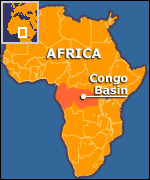
Thinking about Congo Basin the first thing that comes to our minds will probably be the wonderful heritage that this place represents for our world. Reflecting about the wonderful landscapes this place contains, I realized that it is not only a touristic destination, but it represents something more crucial to all of us, and for that it should be protected from the commons dangers of pollution and deforestation, and  in this article I will show you who is taking care of its survival.

It is a common knowledge that Congo Basin, with its natural network of forests, that spain six countries : Cameroon, the Central African Republic, the Democratic Republic of Congo, Gabon, Equatorial Guinea and the Republic of Congo is one of the most important place for the climatic equilibrium of  Earth.  It is this amazing extension that makes Congo Basin second in size only to the Amazon Forest in South America.

According to the previous reasons, Congo Basin’s importance for Earth can’t be denied. Despite of, as a study reported by the University of Endiburgh, the increasing demand of food, shelter and fluel, coming from the near zones is creating a great cost for the forest. Many acres  were cut in order to respond to this demand, and this is one of the main reasons, together with agriculture, that made of the deforestation in Congo one of the most debated facts in our society.

In the forests of the Congo Basin can be found the greatest number of mammals, amphibians, birds and other wildlife species in Africa. Furthermore a lot of indigenous groups are currently living there, and deforestation is a great danger for their survival. These are the  reasons that , in 2002, persuaded Colin Powell to launch the CBFF (Congo Basin forest fund).

Thanks to the efforts made by Colin Powell, CBFF is now able to bring together more than 70 partners, including not only African countries but also international organizations, donor agencies, NGO’s and other organizations coming from the private sector. The main aim of this fund is to sustain forest resources of the Congo Basin. All these partners cooperate a lot also in the international environment, collecting great amounts of donations.

The objective of this great partnership is to raise the effectiveness of the partners’ programs and initiatives, following the spirit of the Paris Declaration on Aid Effectiveness, which is the basis of the fundamental principles of the partnership implemented by Congo Basin Forest Fund.

CBFF members are working in order to implement international initiatives that will aloud to:
- Harmonizing forest policy and taxation
- Resource knowledge and inventory
- Ecosystem management
- Biodiversity conservation
- Sustainable use of forest resources
- Alternative income generation
- Capacity development and training
- Research
- Innovative financing mechanisms
- Regional cooperation and partnerships


The initiative concerning these objects is realized not by playing a direct part in the program but, in order to emphasize regional  and international cooperation, CBFF plays the role of a medium connection between donors and implementing agencies, which are the major actors in the project proposed by CBFF who remains focused on improving dialogue and collaboration between its partners, who constantly increase.


Silvia Pennazzi Catalani

mercoledì 23 aprile 2014


Who takes advantage of deforestation?

The answer to this question is not, for sure, the economy of local communities. This statement, which may seem trivial, is the result of an in-depth joint study by the University of Cambridge and the Imperial College, published in 2009 in the journal Science. The study, focused on Brazilian Amazonia, considered life expectancy and per capita income at different stages of deforestation. Amazonia is one of the least developed regions in Brasil – explains Ana Rodrigues, leader of the reseach team - and people often assume that substituting forests with fields and grazing lands is necessary and acceptable in order to satisfy the requests for development that arise in the region. The researchers wanted to find out if this assumption does actually make any sense. The outcome is that the sudden availability of resources- land, timber, minerals- brings about higher incomes, services, deeper access to education and healthcare, and therefore a higher expectancy of life.  However, once the process of deforestation is over, the multinationals leave the exploited areas and head towards new virgin forests;  loggers, miners, farmers and breeders move accordingly. The quality of life of  local populations gets back to the levels prevailing before the deforestation, because timber runs out and the fertility of land declines. To sum up, deforestation is not able to sustain growth in the long run, while the deleterious environmental damages are permanent.
In this business there are indeed more benefited  players: logging multinationals, often advantaged by corrupted  local Governments.


In the past, in fact,  lands and related resources were often patrimony of local communities, whose survival had heavily depended upon forests for millemnia.  Only in recent times they were declared property of the State: this is for instance what happened in Indonesia in the Seventies. This setting is not a priori negative, and could instead theoretically offer a guarantee. Unfortunately the Indonesian Government –sadly not the only black sheep- proved more interested in abundant , often illegal profits rather than in environmental protection and the safeguard of indigenous populations. Indeed, it has sistematically sold wide forestal areas to industrial giants that produce paper and palm oil. Populations are of course not called to express their opinion when such choices are made: they are usually just forced to abandon their homes, and their rebellions are violently suprressed by “security” forces.
Once obtained the concessions, deforestation, especially in tropical areas, is often practiced with the slash-and-burn method: trees are cut, and what remains –a rich underbrush- is set on fire. The resulting ash fertilizes the soil, but only for a short period. After a few years, it becomes unproductive, and another area is cleared. The habitat of the undergrowth is, instead, forever gone. The situation is even worse in countries like Indonesia, where the soil is made of peat, substance that, when exsiccated, releases carbon dioxide (CO2), responsible for the green house effect. The systematic change of use of land, converted from forests to agricultural fields, accouns for about one third of the total greenhouse gas emissions, according to the UN Food and Agriculture Organization (FAO).

This widespread illegality, which produces in this sector a yearly turnover of 150 billion dollars according to the OCSE, is not only an economic loss for exporting countries; it negatively affects the International markets (for example in the case of money laundering), and, furthermore, it produces a dumping effect. In fact the abundance on the market of low-cost timber discourages a sustainable utilization of forests, since it would imply higher costs and therefore result in non-competitive products.
It is obvious that a precise political will is needed to face the global gigantic problem of deforestation, in both exporting and importing countries. The European Union has been moving in this direction, voting in 2011 a ban on the import of illegal timber. However, Greenpeace denounces that, when it comes to application, rules are not so hard-and-fast.
But what can we do as consumers? It is mainly a matter of awareness. For instance, when we buy a wooden piece of furniture, distinguishing between pine-wood and birch, ash-wood and oak should not be our only concern. There is, in fact, a certified wood and a non-certified one. On all products that come from trees, from wardrobes to paper, we can find two types of certifications, released by the FSC (Forest Stewardship Council) and the PEFC (Programme for the Endorsement of Forest Certification) respectively. The concession of this guarantee implies an engagement in a socially and ecologically  sustainable management of forestal resources, which means maintaining biodiversity, productivity, regeneration capacity, vitality and potential to fulfill, now and in the future, relevant ecological, economic and social functions at the local, national and global levels, without harming other ecosystems.

What is clear is that, as inhabitants of this planet, we will be all harmed by short-sighted environmental policies, unable to see beyond short-term interests: “Imagine if trees gave off Wifi signals: we would be planting so many trees, and probably save the planet too. Too bad they only produce the oxygen we breathe”.


Valentina Rutigliano

martedì 22 aprile 2014


Writing this article took me awhile. I reflected a lot on the forests protection and its value. What drew my attention was how people deal with it. The truth is that not everybody is worried for the ecosystem health. By worrying, I mean doing something concrete for the environment protection.

Why?
1) We are all too busy. The routine. It takes all the energy we have: work, study, projects, family, friends and so on.
2) The common belief that “there’s somebody else or something that takes care of it”.
We are all somehow absent-minded and our thoughts are kept by our personal life.
The world outside there is strong enough and it doesn’t need us. Well that’s not true. Mother nature needs us to pay attention and to protect her.
We all can do simple stuff to save the Earth. The essential factor to make a change is awareness. Awareness of the forests protection emergency, but also of the key role played by our behavior.
So, here it is:
Forests are made of trees. Trees produce oxygen, an essential gas for our survival. More precisely by taking in CO2 and releasing O2, they clean the air, so we, as people, and the animals can breathe.
Another important thing they do is cooling the earth’s temperature, by giving shade and recycling water. Trees absorb water from the soil for nourishment and when the sun shines, water is released from the leaves and absorbed back into the atmosphere. When the sun’s energy removes water from the earth’s surface, the water collects into clouds and when the clouds are heavy enough, they release rain back to the earth.
Furthermore, trees provide food, like fruits and nuts. But also medicine, in fact, illnesses such as cancer and malaria are treated with drugs made in part from plants.
How not to mention the biodiversity living in forests. More than 10 million different species of animals, plants and other organisms inhabit the Earth and almost half of them live in forests, including 80% of biodiversity on land.
And now, the equilibrium of the ecosystems is changing, because of us.
Deforestation is about cutting away trees, but it does not affect only them. In fact, this process makes the entire ecosystem fall apart, with dramatic consequences for everybody.
The individual behavior is crucial and it can make an impact. The first thing to keep in mind is to recycle more and to re-use items. But, surfing the internet, I found a better way to explain what we all can do to protect forests, which is called TREES.
T for teach others about the importance of the environment
R for restore damaged ecosystems by planting trees where forests have been cut down
E for encourage people to live in a way that doesn’t hurt the environment
E for establish parks to protect rainforests and wildlife
S for support companies that operate in ways that minimize damage to the environment
As reported by the FAO for the international day of forests 2014 “Forests are part of our life. They protect us as we grow, they clean the air we breathe, they give us food, water and health. They provide shelter, employment and income. Look around, can you imagine your life without them? Sustain them, they are our future.”


Jona Shehu

venerdì 18 aprile 2014

“Every two seconds, an area of forest the size of a football pitch is lost to logging or destructive practices”, Greenpeace states. And along with forests, Earth is losing biodiversity, carbon absorption and natural resources, while greenhouse effect and desertification are increasing.
So, are humans going into the right direction to stop this frightening trend?
Not at all, according to some researchers from the University of Guelph (Canada): in their opinion, forests (which now cover 30% of the land surface) will continue shrinking, covering just 22% of total land area in the next few years. A worrying scenario, if we consider countries like Paraguay, which has the highest rate of deforestation in the world: here, the government has allowed Brazilian companies to destroy the Chaco forests, where the indigenous Ayoreos have been living and protecting their homeland for thousand years.
Luckily, there are also good news: some nations have taken steps to help increase the amount of trees on Earth. In 1981, China created National Tree Planting Day Forest: as a result, forest coverage has now reached 16.55% of China's land mass, as against only 12% two decades ago, and 12th March is the Planting Holiday.
Even Brazil is reversing its rate of deforestation and increasing the number of hectares in protected areas in the Amazon basin. The Amazon Regional Protected Areas (ARPA) Program is also training local communities to ensure the preservation of natural resources and to prevent and extinguish forest fires. The outcome has been a 37% decrease in deforestation between 2004 and 2009.
Sao Felix, a small town in Bahia region, is the symbol of this new approach: previously famous for its severe deforestation, now it is engaged in an important fight against it and it is the city that most reduced deforestation starting from 2005.

Without any doubt, Canada is one of the best countries in managing its 400 million hectares of forests: they represent around 10% of the world forest coverage and companies destroying them have to rapidly arrange for regeneration. As a consequence, the deforestation rate is almost zero and Canada has 90% of the forests it used to have before colonization.

If you’re wondering about Europe, you should know that forests cover 40% of the Old Continent and they represent a key resource for improving the quality of life and creating jobs. Last September, the EU Commission  published the new Forest Strategy responding to the new challenges facing forests and the forest sector. Stressing the need to adopt a holistic approach,  the Strategy "goes out of the forest", addressing aspects of the "value chain" (that is the way forest resources are used to generate goods and services) which strongly influence forest management. Moreover, it underlines that linked EU policies should be taken into account in national forest policies.

For this reason, Italy is taking action for a forest restoration, since our trees are threatened by fires, waste disposal, abandon of agricultural land and unsustainable wood cutting. When a forest needs help, two approaches are possible: an active restoration, where man is directly involved in tree planting, and a passive restoration, based on the natural capacity of woods to automatically regenerate.

In both cases, Prof. Mercurio, president of the Italian Society for the Forest Restoration (SIRF), says that this program can be the proper reaction to the current environmental challenges, such as the conservation of biodiversity and water resources and the fight against greenhouse effect and desertification. However, protecting forests has also a deep cultural meaning: it is a necessary action for our natural and social patrimony, whose worth can’t be really estimated.


Chiara Crognoletti

giovedì 10 aprile 2014


The idea of  efficient management of resources  is becoming the driving force for sustainable growth: smart cities and environment-friendly projects are attracting worldwide attention and in this context citizens' involvement undoubtedly plays a fundamental role.

Following this philosophy, the European Competitiveness and Innovation Framework Program  2007-2013 has approved the project “Green Campus” in four pilot Universities.
The project aims at reducing the energy consumption through the development of ICT based services, integrated with existing energy management systems, collecting data and providing guidance that will lead to user behaviour transformation towards more energy efficient practices.

The pilot project is located at University Campuses in Milan (Politecnico), Helsinki (Metropolia), Lisboa (IST) and Luleå (LTU).
What the Politecnico of Milan has been doing is designing specific web applications that allow students and professors to interact with energy management systems; for instance teachers can signal their presence in office and the heating system will automatically turn on, students can book study spots or team workspaces arranged in an efficient way, avoiding waste of light and heat where and when they are not needed. The consumption of energy is shown in real time.
The innovation in this project is the exploitation of a new method, called Living Lab methodology, that has also being implemented in the other three Universities mentioned above. Its aims are the co-design and co-creation of the digital services with the users (that is why community participation is crucial), ensuring higher solution sustainability and better user requirement identification, which translates into a higher success rate of behaviour transformation and long term acceptance of the proposed solution.

Data related to the energy saving performed by the project so far is available at greensmartcampus.eu

Moreover, Politecnico and Università Statale of Milan are cooperating to transform the area of Città Studi into a leading sustainable campus.

Finally, someone once said that if you want to change the world you have to change yourself first, we may not be so ambitious in willing to go so far but as students we can help and push our university and community in being more sustainable, we can be more supportive towards green projects, we can keep green! And stay smart.


Wu Fei Fei

martedì 8 aprile 2014


While sustainability themes are gaining more consent than ever worldwide, what is turning out to be an emerging phenomenon is the attitude of some schools and universities (especially the private ones) to pursue sustainability for their own structures, trying to make their campuses as greener as possible.
One remarkable example in Europe is ESADE Business School in Barcelona, already widely known for its commitment for Corporate Social Responsibility, which is one of its core missions. ESADE is in fact a  signatory of the United Nations Global Compact , and of PRME - Principles for Responsible Management Education - a global network of universities and business schools committed to integrating social responsibility, ethics and sustainability into education. ESADE also joined the United Nations Higher Education Sustainability Initiative for Rio+20.
The business school is also active  in making its structures greener: Net Impact ESADE Club (ESADE's CSR-based club) is a network of students with a keen interest on corporate social responsibility with the aim of promoting sustainable business practices within the university and the larger business community.  And a Net Impact regular activity is, among the others, Campus Greening-activities including selling eco-friendly water bottles, promoting the use of water fountains on campus, improving recycling facilities, working towards carbon neutrality on campus, and raising awareness of environmental issues among students and faculty.
ESADE is also involved in the international student network Oikos, an international organisation for sustainable economics and management and a reference point for the promotion of sustainability. Oikos Barcelona is a local chapter of Oikos international and it is established at ESADE and formed by a group of its students.


Costanza Gabbrielli

domenica 6 aprile 2014

(English version below)

Dal 25 novembre 2013 sono presenti, all'interno dell'Università, due distributori di acqua microfiltrata e refrigerata . La novità introdotta è stata lanciata da"Bocconi Green", la nuova area dell'Università Bocconi creata per la promozione di iniziative come quella che stiamo raccontando.
I due distributori sono collocati al pianterreno degli edifici di via Sarfatti 25 (la sede storica dell’Università) e di piazza Sraffa 13 (l’edificio ad aule comunemente denominato Velodromo ).
Le case dell'acqua danno la possibilità agli studenti muniti di apposito badge , reperibile presso la libreria Egea di via Bocconi, di erogare mezzo litro d'acqua (sia liscia che gasata) e di utilizzare sia borracce (anche queste disponibili per l'acquisto presso l'Egea), sia qualsiasi tipo di bottiglietta di cui già si dispone. Ogni mezzo litro d’acqua costa 10 centesimi .
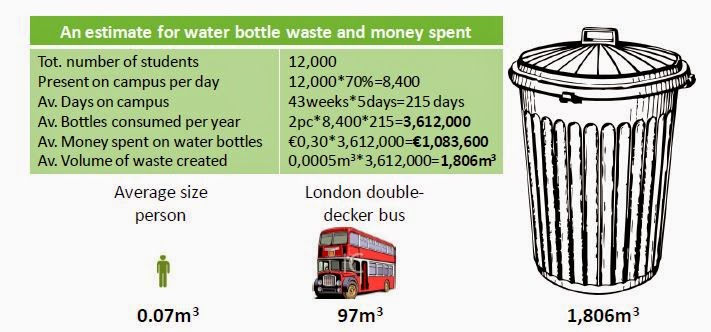
In base alle nostre stime, considerando indicativamentemente che il 70% della comuntità di studenti bocconiani transita per l'Università e consuma all'incirca 2 bottigliette d'acqua al giorno, potremmo risparmiare l'utilizzo di 3,612,000 bottigliette l'anno , pari a 1.806 mc di spazzatura creata . Un numero pazzesco se si pensa a quanto si potrebbe evitare se la maggior parte degli studenti si portasse ditero un proprio contenitore per l'acqua.

E' bene inoltre ricordare che tutto questo è stato fatto nell'ottica, ben esplicitata dal rettore Andrea Sironi, di operare "intervenendo anche sulle abitudini della comunità bocconiana e diffondendo allo stesso tempo la consapevolezza dell’importanza dei comportamenti sostenibili".

English version
In our University there have been vending machines distribuiting microfiltered and fresh water since November 25 2013. This kind of innovation has been introduced by “Bocconi Green”, a new area of development in Bocconi established for the promotion of initiatives like the one we are telling.
The two  vending machines are located at the ground floors of the Sarfatti 25 (the historic structure of the University) and of the Piazza Sraffa 13 (commonly called Velodromo ) buildings.
The two “case dell’acqua” (literally houses of water) let students, having a special badge (available at the Egea library in via Bocconi), get water, both sparkling and still, and to use the ad-hoc bottles (also available at Egea) or any other type of bottle. Every half litre of water costs 10 cents .
Our estimates, considering approximately that 70% of Bocconi students passes by the university each day and that each student consumes on average 2 bottles of water per day, we could save 3,612,000 bottles per year, equal to 1.806 mc of waste created. A huge number if we think how much waste we could avoid if the majority of students carried with themselves a personal empty bottle.
It is also useful to remember that all this has been done with the intention, as suggested by the dean Andrea Sironi, to operate intervening also on the habits of the Bocconi community and at the same time spreading the awareness of the importance of sustainable habits.

giovedì 3 aprile 2014

Contrariamente a quanto previsto inizialmente con gli altri blogger, nel mio articolo non parlerò di alcuni dei comportamenti sostenibili che le università americane mettono in atto o stanno sperimentando ( maybe next time! ), ma racconterò esperienze concrete di lotta contro lo spreco messe in atto da alcune mense scolastiche italiane.
La decisione è stata presa quando sabato scorso, durante la fiera "fa la cosa giusta!" di Milano, durante un incontro dal tema "ecofeste", un giovane volontario ligure ha raccontato di come una scuola della Provincia di Genova aiuti la sua mensa per i poveri fornendo il cibo che avanza e che altrimenti verrebbe buttato via.
La scuola è quella di Campomorone, e la mensa di cui sto parlando è " la Mensa Fassolo" dei Padri Vincenziani . "Spulciando tra le scartoffie informatiche" ho trovato che per fortuna questo non era l'unico esempio di collaborazione virtuosa tra due soggetti che non hanno che da guadagnarci da una relazione del genere. Per esempio, il Comune di San Giovanni Lupatoto in provincia di Verona ha da poco siglato una convenzione tra la società che si occupa del servizio di ristorazione e un'associazione che distribuisce cibo alle persone bisognose. Si ipotizza che le rimanenze varino tra le 20-100 porzioni al giorno, e un aiuto del genere non passa certo inosservato in un comune da 24,171 abitanti (fonte: Wikipedia). Quello che è ulteriormente interessante riguardo a questo comune è che l'aiuto non si ferma alle persone: da qualche mese all'associazione di volontariato San Francesco vengono dati gli avanzi di cibo che rimangono nei piatti, la quale li usa per dar da mangiare ai cani e ai gatti maltrattati e abbandonati di cui si prende cura.

Anche il Comune di Milano si sta attivando in questo senso dopo che a ottobre era iniziata una campagna di sensibilizzazione sugli sprechi. Si sottolineava che 8,6 tonnellate di cibo venivano buttate via ogni anno dalle mense scolastiche. Questo ha portato alcuni a pensare ad una doggy bag all'americana, con i bambini che si portano a casa quanto avanzato a pranzo per mangiarlo loro stessi o darlo ai poveri del quartiere. Ai bambini delle scuole che aderiscono all'iniziativa è stato dato un sacchetto (per alimenti, lavabile) in cui depositare i cibi che si possono conservare a temperatura ambiente. In più, si vorrebbe che alcuni degli anziani bisognosi venissero direttamente nelle scuole per convidere il pranzo con i ragazzi, così da poter usufruire anche dei cibi caldi che per questioni di conservazione non possono rientrare nella doggy bag.

Altra questione importante, sempre legata al mondo delle mense scolastiche, è quella della stoviglie. Plasica sì o plastica no? Mentre la città meneghina rimane sul sì per questioni economiche, altre città hanno, o parzialmente o totalmente, abolito questo materiale inquinante. Tra quelle dell'ultimo tipo segnalo la capitale, dove ai giovani studenti viene servito il pranzo completamente in piatti di ceramica, bicchieri di vetro e posate d'accaio. Questo avviene dal 2007 e nelle scuole dove il lavaggio non è possibile, si usano stoviglie compostibili.

Ultima info aggiuntiva: esistono le "scuole verdi"! leggere per credere: www.scuoleverdi.it .

*il titolo riprende il nome della campagna ministeriale francese contro lo spreco alimentare ( http://alimentation.gouv.fr/manger-c-est-bien-jeter-ca-craint )


Maria Carolina de Vera

martedì 1 aprile 2014

L’economia domestica ha la sua dose di responsabilità nelle odierne emissioni di CO2. Molto spesso la causa primaria consiste nella struttura degli edifici a volte eccessivamente estesi da esigere inevitabilmente elevati livelli di riscaldamento. Una superficie di 10 mq e un arredamento essenziale sono la soluzione che l’équipe di architetti svedesi dello studio Tengbom, con la Student Smart Unit , ha proposto all’ Università di Lund .
La Student Smart Unit è una delle iniziative più originali dello studio Tengbom, da sempre molto legato al tema della sostenibilità. Interamente costruita in legno, questa micro casa dall’estensione così ridotta è un indiscusso capolavoro d’ingegno. In soli 10 mq si trovano angolo cottura, bagno, soggiorno e zona notte. Un allestimento essenziale certo, ma studiato nei minimi dettagli al fine di poter meglio rispondere alle esigenze degli studenti. Il ribaltamento di una persiana dà vita ad una scrivania, e una piccola amaca sostituisce elegantemente il classico sofà. L’architettura non è il solo pezzo forte della Students Smart Unit, eccellente è anche il design: da qualsiasi angolatura la si osservi, in questi 10 mq non si vedono spigoli. Quest’ultimi, alquanto pericolosi in spazi ridotti, sono stati infatti sostituiti da spazi curvi, la cui realizzazione è stata resa possibile dall’incrocio dei pannelli di legno utilizzati nella costruzione.

L’Università di Lund, con cui lo studio Tengbom ha collaborato per la realizzazione, ha subito compreso i potenziali vantaggi della Student Smart Unit. Innanzitutto l’utilizzo del Cross Laminated Timber, pannelli incrociati di legno laminare, permette una riduzione delle emissioni di carbonio pari ad oltre il 50% rispetto ad un normale edificio. Considerato l’alto numero di iscritti all’ateneo il potenziale risparmio potrebbe raggiungere indici notevoli. In secondo luogo, viste le scarse dimensioni, il costo di locazione della Student Smart Unit si mantiene su prezzi molto bassi, il che costituisce dunque un’eccellente soluzione economica al problema degli alloggi studenteschi.

Entro la fine del semestre, verrà realizzato nel campus dell’Università di Lund un piccolo villaggio di 22 micro case, che costituirà la prima sperimentazione concreta della Student Smart Unit. L’obiettivo è la progressiva diffusione di questi micro villaggi negli atenei svedesi, in perfetta linea con le altre brillati iniziative ecosostenibili, come il “ Villaggio Hobbit ” nei dintorni di Stoccolma o la serra verticale urbana , che hanno permesso alla Svezia di posizionarsi in cima alla classifica dei paesi più attenti all’ambiente.


Silvia Pennazzi Catalani